Vocational training—the 'key' to the future
Vocational training not only creates immediate job opportunities but also helps workers improve their capacity and escape the vicious cycle of poverty. In Tay Ninh, many stories of overcoming difficulties through vocational training have proven that vocational education is the "key" that opens the door to a new life, making an important contribution to sustainable poverty reduction.
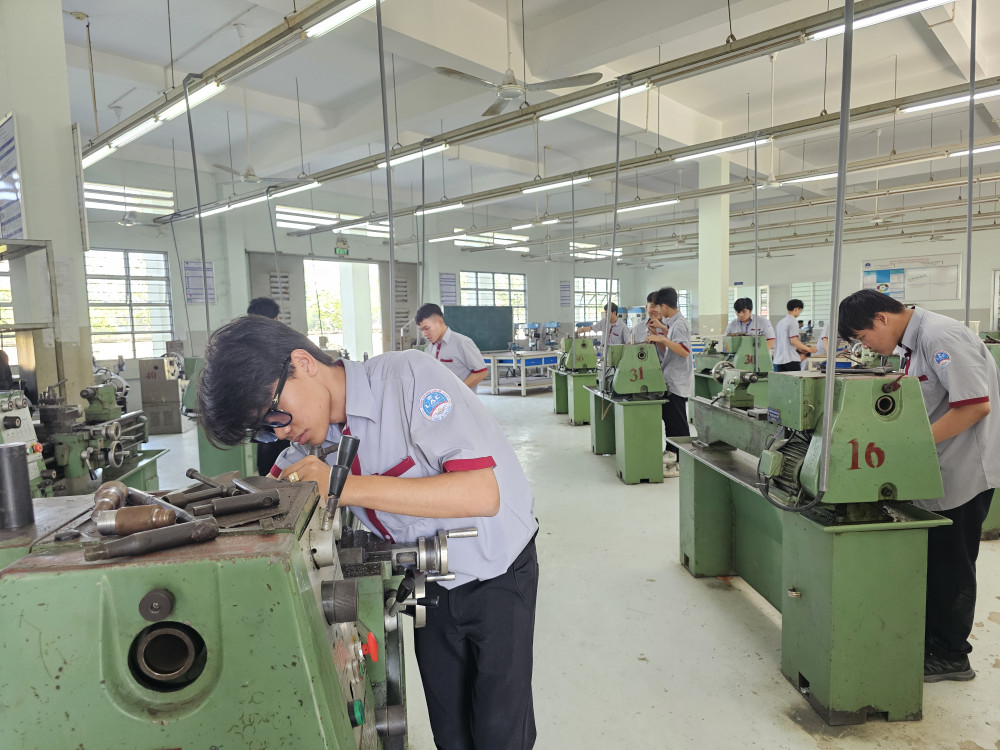
Vocational training institutions in the province focus on improving teaching programs to meet market needs (Photo: A class at Long An College)
Improving life through vocational training
Mr. Nguyen Ngoc Minh Khang is currently a lecturer in the field of Refrigeration Engineering at Long An College. He was once a poor student who had to study, work part-time, and take care of his paralyzed grandfather.
Due to family events, Mr. Khang lived with his grandfather since he was a child. In 8th grade, his grandfather suffered a stroke and completely lost his ability to work, making Khang the "breadwinner" of the family. The situation was so difficult that the only thing Khang thought about when choosing a major was to learn a profession quickly to get a job to support his family.
With the school's support through scholarships, preferential policies for students in difficult circumstances, and a vocational learning environment associated with practice, Khang graduated with good results, was retained as a lecturer, and continued to study at university.
Mr. Khang said, “When I have a job, I can escape from a difficult life to take care of my family. Now, as a lecturer, I often remind my students, especially those in difficult circumstances, to study hard because it is an opportunity to escape from a difficult life.”
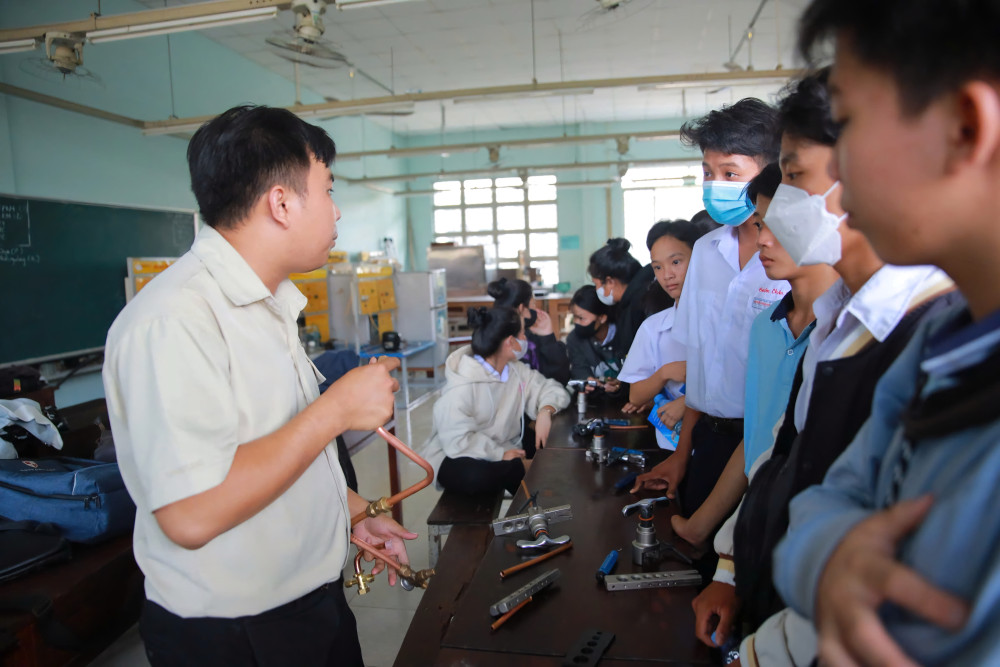
After many efforts to learn a profession, Mr. Nguyen Ngoc Minh Khang has a stable job and is currently teaching at Long An College
Mr. Khang's story shows that sustainable poverty reduction must start with creating livelihoods. Workers are not only supported with money or social security policies, but more importantly, they are equipped with knowledge and vocational skills to generate income. When equipped with a profession, workers can create jobs for themselves, participate in the high-quality labor market, and increase their income value.
In Tay Ninh province, vocational training is identified as one of the important solutions in poverty reduction. In 2025 alone, the budget for vocational training for workers from poor, near-poor households, newly escaped-poverty households, and low-income workers in poor and disadvantaged areas has reached nearly 6.5 billion VND. The enrollment rate from primary to college level in the whole province reached over 99% of the plan.
Along with budget investment, vocational training institutions in the province focus on improving programs according to market demand, increasing practice, and cooperating with businesses to ensure output for students. At Long An College, cooperation with businesses during the training process is of particular concern.
Through coordination activities between schools and businesses, the school's training program is close to the actual needs of businesses. Students are given opportunities to practice at businesses to practice skills, industrial style, and have more opportunities to find jobs. In addition, the school also cooperates with businesses to create opportunities for students to work abroad after graduation. Thanks to that, the employment rate after graduation is always high.
In addition, in order to create conditions for students from poor, near-poor households and difficult circumstances to be able to confidently pursue their studies, Long An College strives to mobilize funds to give gifts and scholarships to students who overcome difficulties.
Principal of Long An College Le Quoc Hung informed that every year, the school mobilizes to award scholarships to poor, near-poor, and disadvantaged students with a budget of about 2 billion VND. In addition, the scholarship fund to support students to go to school, contributed by teachers and staff of the school, is also maintained, supporting many generations of students.
“Our biggest goal is to help students find stable jobs after graduation. However, to help them study well, supporting and helping them when they are in difficulty is also very important,” Mr. Le Quoc Hung affirmed.
The family of Truong Minh Tri—a second-year student majoring in electronic motors at Long An College—is a near-poor household in My An commune. He was considered by the school for a scholarship from the Golden Heart Fund of Lao Dong newspaper. Holding 2 million VND in his hand, Tri could not hide his joy.
"This will be my living expenses for 2 months, helping my family to ease some of the worries in the days near the end of the year. With my good academic performance, I hope to find a job right after graduation. I am also focusing on learning foreign languages with the hope of having the opportunity to work abroad to help my family escape from difficult situations," Tri shared.
Improving income for sustainable poverty reduction
In addition to professional vocational training at vocational training institutions, rural vocational training is also given special attention to improving the quality of rural labor, helping farmers learn more trades or work in their old trades with higher qualifications. This is a transition from experience-based production to knowledge-based production, creating added value through techniques and technology.
Rural vocational training classes are organized by local authorities to survey actual needs and coordinate with vocational training centers, helping farmers improve their skills or change their livelihoods and often receive attention from the people. Since the beginning of 2025, the whole province has organized 29 agricultural vocational training classes, with 940 students. The main trained occupations are high-tech rice cultivation, yellow apricot, water-based apricot, high-tech vegetables, fruit trees, high-tech dragon fruit, safe straw mushrooms, oyster mushrooms, veterinary medicine on livestock and poultry, etc.
Rural vocational training classes are organized quite flexibly in terms of both time and teaching methods, providing farmers with more knowledge about science and technology. Combined with existing experience, farmers can produce more effectively, thereby increasing income and developing the family economy.
According to the Economic Department of Phuoc Ly commune, in order to create conditions for farmers growing yellow apricot and water-based apricot to grasp the techniques of planting, caring for, and shaping the trees, the locality organized a vocational training class and attracted 30 students who are farmers in the commune to participate. Due to the high demand for learning how to grow apricots in the locality, the commune plans to open another class to teach yellow apricot and water-based apricot growing and a class to teach how to make jelly at the end of this year.
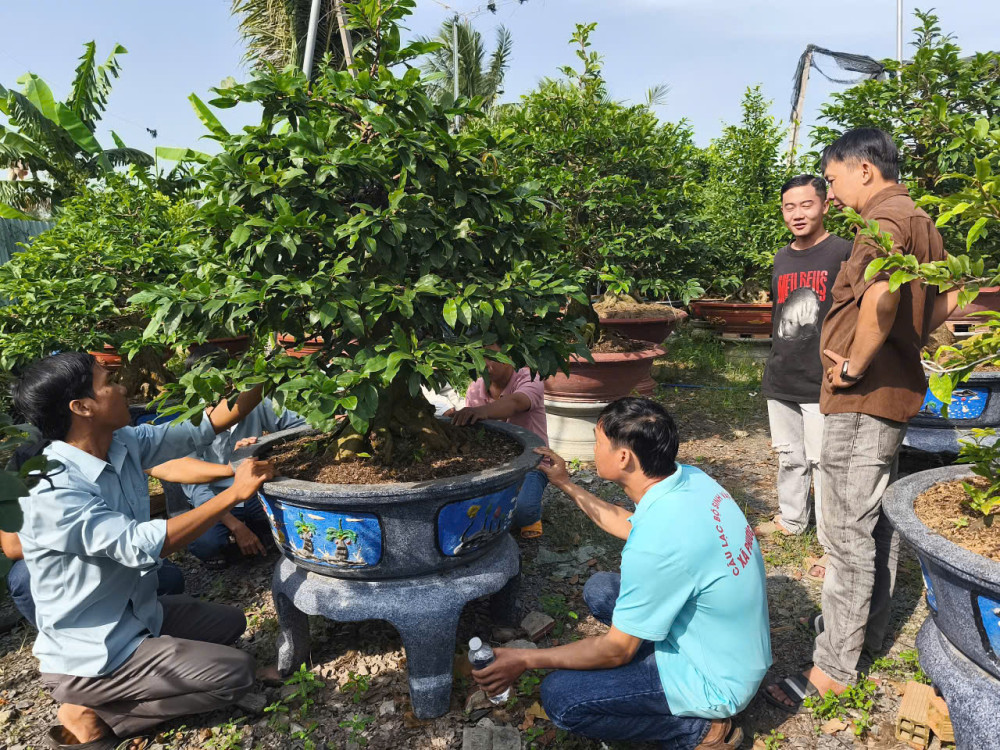
Trainees practice on growing yellow apricot and water apricot trees in Phuoc Ly commune (photo provided by local authorities)
In addition, rural vocational training is often associated with livelihood support and access to loans, contributing to increasing the effectiveness of poverty reduction. These models not only help workers find jobs immediately after training but also reduce re-poverty by creating a stable source of income.
It can be seen that vocational training is not only a support policy but also a solution to help people stand firm on their own abilities. When workers have a profession and a stable job, they not only escape poverty for themselves but also create a sustainable foundation for their families and communities. Investing in vocational training is therefore investing in a future without poor households./.
By Que Lam - Translated by Q. Thien
Source: https://baolongan.vn/dao-tao-nghe-chia-khoa-mo-canh-cua-tuong-lai-a207345.html